When Consultation Helps—and When It Gets in the Way: Rethinking Employee Voice in Modern Leadership

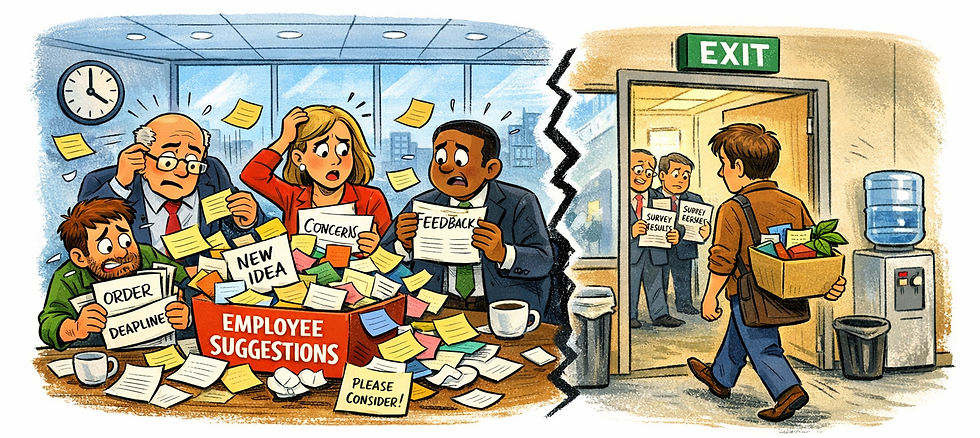
We talk a lot about the importance of employee voice, and rightly so. People want to feel heard, valued, and involved in shaping the work they do. At the same time, leaders are encouraged to be inclusive, collaborative, and consultative. On paper, it sounds like a complimentary situation.
But in practice? It’s more complicated.
There’s a point on the consultation spectrum where “inclusive” becomes “inefficient,” and a point on the directive spectrum where “decisive” becomes “disengaging.” Most organisations oscillate somewhere between the two—rarely landing in the sweet spot where consultation genuinely adds value without slowing everything down.
Let’s unpack that tension a little.
The Hidden Cost of Over‑Consultation
Leaders often consult widely because they want to do the right thing. They want buy‑in. They want to avoid blind spots. They want to be fair.
But consultation isn’t free.
It takes time—time that could be spent delivering, iterating, or solving the next problem for clients i.e. generating revenue.
It raises expectations—if you ask for input, people naturally expect to see it reflected in the final decision.
And when it isn’t? Engagement drops. Fast.
Employees who feel “consulted but ignored” often become more frustrated than those who were never consulted at all. It can feel performative, even disingenuous, and that sense of disappointment can quietly erode trust, motivation, and retention.
Over‑consultation can also create noise. When every decision becomes a group decision, clarity suffers. Priorities blur. The organisation slows down. And ironically, the very people leaders are trying to empower end up feeling stuck in endless loops of discussion rather than meaningful progress.
The Risks of Being Too Directive
On the other end of the continuum sits the overly directive leader—the one who makes decisions quickly, independently, and with minimal input.
There are moments when this is exactly what’s needed. In a crisis, for example, decisiveness is a gift.
But when directive leadership becomes the default, employees start to feel shut out of decisions that shape their work, their wellbeing, and their future. They lose the sense of agency that fuels commitment and creativity. They may comply, but they rarely thrive.
And just like with over‑consultation, the result is predictable: disengagement, reduced performance, and eventually, attrition.
So What Does Effective Leadership Look Like?
The answer sits in the thoughtful, intentional middle.
Great leaders don’t consult more or less—they consult wisely. They understand that employee voice is most powerful when it’s channelled into areas where people can genuinely influence outcomes and see the impact of their contribution.
This is where trust comes in.
When leaders demonstrate competence—clear thinking, sound judgement, and an ability to navigate complexity—employees don’t need to be consulted on everything. They trust that decisions are being made well, even when they’re not directly involved.
And when leaders create structured, meaningful avenues for employee input—rather than open‑ended, expectation‑raising consultations—people feel heard in ways that matter.
The result is a virtuous circle:
Leaders make confident, well‑judged decisions.
Employees trust the process and feel respected.
Consultation happens where it can genuinely shape outcomes.
Employees see their input reflected and feel valued.
Engagement, performance, and retention rise.
Everyone wins.
A More Mature Conversation About Voice
Employee voice isn’t about giving everyone a say in everything. And leadership isn’t about choosing between being democratic or directive.
It’s about clarity. It’s about discernment. It’s about knowing when consultation will unlock better thinking—and when it will simply dilute focus and slow the organisation down.
Most importantly, it’s about creating an environment where employees feel their contributions matter, even when they’re not part of every decision.
When leaders get this balance right, consultation becomes a strategic tool rather than a default behaviour. Employees feel genuinely empowered. And organisations move faster, with more cohesion and less friction.
That’s the kind of leadership that builds trust. And trust, more than anything else, is what keeps people engaged, committed, and performing at their best.


Comments